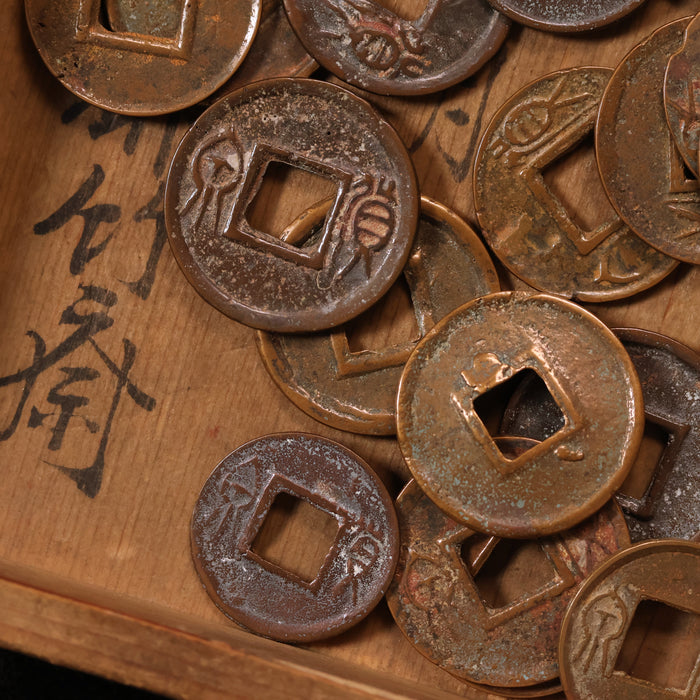
China, Xin Dynasty, Emperor Wang Mang, Huo Quan Cash Coin - c. 14 to 23 CE - Ancient China
China, Xin Dynasty, Emperor Wang Mang, Huo Quan Cash Coin - c. 14 to 23 CE - Ancient China


Couldn't load pickup availability
Money-Back Guarantee
Money-Back Guarantee
If you're not completely blown away by the experience, we'll give you a full refund no questions asked, you have 30 days to request a return.
100% Secure Check Out
100% Secure Check Out
Your information is fully protected with top-notch security technology. Shop with complete confidence and peace of mind.
Sale – Last 48 Hours!
Sale – Last 48 Hours!
Once the promotion ends, the product will return to its original price.
Order now before it's sold out again!
PLEASE READ: Our shipment of small display boxes has been delayed. Small display boxes are currently out of stock and are expected to arrive around October 1st.
You can still pre-order items that include a small display box. These items will not ship until the display boxes arrive.
Pre-orders receive $5 off each delayed item.
In-stock items in the same order will ship immediately as usual.
These ancient Chinese "Huo Quan" coins date back to the reign of Emperor Wang Mang (7–23 CE), whose most significant contribution to China’s monetary system was plunging it into chaos.
Wang Mang came to power by usurping Ruzi, the child emperor of the Han dynasty, for whom he was supposed to serve as regent until the emperor was old enough to rule. Wang Mang then declared himself the founder of the Xin dynasty and introduced sweeping reforms, including changes to the nation's money.
The new emperor aimed to phase out the Wu Zhu, a popular type of bronze coin that had been used for centuries under the Han dynasty. Between 9 and 10 CE, Wang Mang introduced a complex and confusing currency system involving tortoise shells, cowrie shells, gold, silver, and a reintroduction of the old spade money.
This new system was disliked by the Chinese population, who continued to use the old Han Wu Zhu coins despite Wang Mang threatening exile for doing so. Eventually, in 14 CE, he relented and reinstated a simpler copper currency system consisting of these Huo Quan cash coins, which were minted in a variety of weights and sizes. Of all the coins produced during the Xin dynasty, the Huo Quan would prove to be the most popular.
Nevertheless, his unsuccessful reforms contributed to his downfall, and in 23 CE, Wang Mang was killed in a rebellion, ending the Xin dynasty after just 16 years.
Huo Quan (貨泉), which roughly translates to "wealth coin," is inscribed on each of these coins in seal script.
Each includes a Certificate of Authenticity and is guaranteed genuine.